
Lionel Berthet – Deputy Director of Knowledge of Hazards and Prevention, Natural and Hydraulic Risks Department, General Directorate for Risk Prevention, Ministry of Ecological Transition and Territorial Cohesion (testimony from the “30 years of research for flood prevention” dossier – 2022)
Three questions for Lionel Berthet :
What is the relationship between risk prevention at the DGPR and scientists?
“Within the DGPR, the Sub-Directorate for Knowledge of Hazards and Prevention is responsible for flood and coastal risks, natural land-based risks (such as landslides, avalanches and earthquakes) and the safety of hydraulic structures. It employs around thirty people. Since I started my career, I’ve noticed that collaboration with INRAE scientists was already well established. For us, in the central administration or decentralised departments, INRAE is a pool of scientists who carry out demanding and operational research: we know we can count on them to understand and react to complex and fairly rare phenomena, as in the recent case of Storm Alex, to characterise the hazard, or to build a socio-economic analysis grid for reconstruction. The agreement that structures the INRAE/DGPR cooperation includes a strong emphasis on supporting research activities, in particular to gain a better understanding of the various natural hazards. This knowledge is essential for developing the various tools used to prevent and protect populations”.
Is it fair to say that the risk of flooding has increased?
“When faced with a rare and intense event, we tend to think of it as the most catastrophic we’ve ever experienced. In reality, we need to look at the issue of risk from a historical perspective: the most recent damaging floods along the Loire and Seine rivers in 2016 and 2018 are nothing like the devastating flooding of the Seine in Paris in 1910. It would also be an understatement to say that more and more people are exposed to flooding. A study by the Caisse Centrale de Réassurance (Central Reinsurance Fund) shows that, in reality, prevention tools have made it possible to contain costs and damage. What’s more, we have increasingly reliable models (especially thanks to INRAE’s studies) for forecasting and simulating, an essential step in anticipating action and preventing and limiting damage, particularly for human beings”.
What are the scientific issues of today and tomorrow?
“There are still many questions that require scientific progress. Firstly, there is still room for improvement in hazard characterisation for several natural phenomena. This is all the more the case when they need to be described on a small spatio-temporal scale. For example, while the characterisation of major rivers’ flooding is generally satisfactory, progress is needed to describe and anticipate the risks associated with rapid flooding and even more so with run-off. For the future, knowledge of the effects of climate change on hazards is very diverse: while there is a fairly good scientific consensus on the rise in mean sea level, it remains difficult to estimate the effects on intense rainfall, particularly in the south of France, and even more so on the resulting flooding due to the multiplicity of factors to be taken into account, particularly soil moisture. In addition to flooding, the risks associated with forest fires and drought need to be clarified scientifically, and INRAE is working with us on these issues. The support of scientists is more vital than ever. The dialogue with this community, which began more than 20 years ago and is working very well, must continue.”
Testimonial from our thematic dossier
Thematic dossier
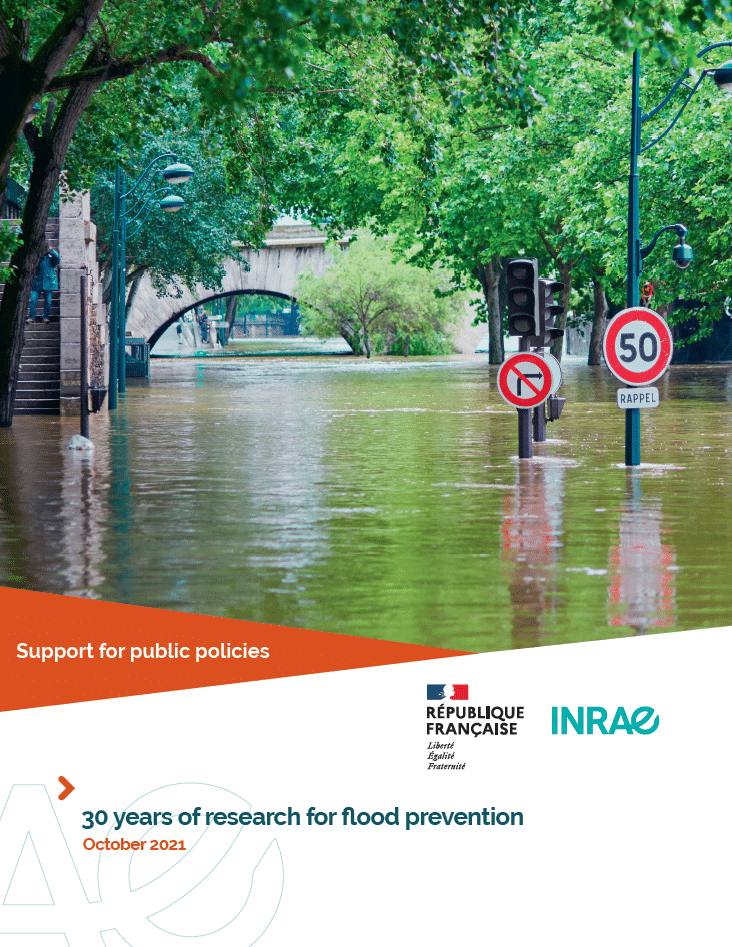
30 years of research into flood prevention
The risk of flooding is the leading natural hazard in France in terms of impact and extent. As experts in water-related risks, six INRAE scientific teams are helping to implement flood prevention policy. They are working on tools and methods for forecasting and preventing this risk, which are presented in this dossier.