INRAE public policy support: mission and players
In 2020, INRAE set up a dedicated public policy support organisation to better anticipate, structure and develop public policy support activities for public players such as ministries, agencies, local authorities, European and international institutions, etc. These activities encourage the sharing of research knowledge to inform decision-making and public debate, which in turn foster research with the emergence of new questions.
INRAE’s Contract of Objectives, Resources and Performance calls for the full deployment of its mission to support public policy. It accompanies this major strategic change that is taking place in a growing number of scientific institutions. For example, in 2021, INRAE began sharing concepts, strategies and concrete practices in support of public policy with around fifteen other French scientific organisations.
Public policy-makers need reliable and robust scientific knowledge to make choices and implement actions to ensure food safety, control risks, manage resources ethically and help societies adapt to the major changes taking place. INRAE, through its Directorate General for Expertise and Support for Public Policies (DGDEAPP) and its ability to conduct studies, forecasts and collective scientific expertise, informs the design of public policies and public debate via the implementation of transparent, multidisciplinary approaches that mobilise experts from various French and foreign institutions. The Institute also provides operational support in terms of developing tools, indicators and access to decision-making aids.
In Europe, the European Commission’s Joint Research Centre has been working to bring science and public policy closer together since it was set up in the 1960s. It supports and inspires initiatives in the various Member States. The research ministers of the EU Member States meeting in Brussels at the end of 2022 confirmed the importance of science in informing public decision-making.
However, collectively building the space between science and public policy is a complex and innovative task. It requires a change of outlook and way of doing things, and the implementation of innovative methods and tools in the dynamics of scientific communities.
Supporting public policy, a key mission for INRAE
Preserving and managing common goods such as water, biodiversity and soil, anticipating and managing natural, food and environmental risks, and initiating food and agroecological transitions are all social issues within INRAE’s remit. These issues require public policies at international, European, national and local levels. International agreements, European directives, national laws, government plans and their regional variations are all tools for public action that require scientific knowledge and expertise.
However, in order to inform public decision-making with substantiated scientific arguments, it is necessary to have high-quality knowledge that has been validated or whose uncertainties are known, providing solid, objective and structuring arguments for public policies. Public authorities also need to find their way around the explosion of scientific knowledge and data produced, stored and analysed on a global scale, as well as the technologies that enable this exponential growth in knowledge and data to be shared. So how can we help to bring science and public policy closer together?
INRAE has set up an organisation dedicated to expertise and support for public policy to bring together the scientific supply useful for public policy and the demand from public players (ministries, local authorities, European and international institutions, agencies, etc.). INRAE’s public policy support activities are carried out by scientists as part of a research-expertise-public policy support continuum, and research can, in turn, be enriched by new questions raised by these activities. In addition to the insights that INRAE can bring to the design or evaluation of public policies, INRAE also provides support for the implementation of public policies by developing permanent public policy support systems that are co-piloted and co-financed with ministries, in particular the Ministry of Agriculture and Food Sovereignty, which oversees INRAE.
To find out more: JRC Science for Policy Handbook
Table of Contents
“Research and public policy are two closely linked yet distinct worlds […]. Their border is not only a barrier, it is also a point of passage and an interface, a place where the question of stance arises.”

David Demortain
INRAE research director – science and public action sociologist
See also
“We need to create new forums for exchange between science and decision-makers”.

Joint interview with Patrick Flammarion, INRAE’s Deputy Director General for Public Policy Support, and David Mair, Director of the Joint Research Centre.
-
What the scientists say
For the European Water Framework Directive: introducing a system to assess ecological status
“[…] Setting up a system for assessing the status of aquatic environments, based on biology, at a national level…”

Christine Argillier
Research Director, aquatic ecologist, INRAE

-
Partner’s testimonial
OFB and INRAE collaborate to improve the quality of bodies of water in Europe
“The implementation of the WFD in France has given rise to a large number of research questions …
Bénédicte Augeard
French Office for Biodiversity (OFB)

-
Partner’s testimonial
TAPs, a public policy being implemented at MASA, supported by scientific expertise…
“Territorial food projects are defined by law, with a framework setting out the broad outlines …
Cédric Prévost
French Ministry of Agriculture and Food Sovereignty

To find out more: JRC Workshop: Scientific expertise and public policy in France
Listening to the needs of public players
The beneficiaries of public policy support activities are the non-academic public partners responsible for designing, implementing and evaluating public policies.
They are the sponsors, co-funders and beneficiaries of the knowledge produced or mobilised as part of INRAE’s collaborative work.
Their needs range from the production of expertise and opinions to the production of knowledge for action. They also need to be able to anticipate issues or identify emerging risks, or to support and monitor existing policies.
The major public policies in INRAE’s domains are often part of European and international agreements and directives. These are implemented and added to national laws and plans at local level. They have a wide range of aims, including plans to combat green algae in Brittany and projects to promote healthy, sustainable food.
Research responses in support of public policy
INRAE’s expertise and public policy support refer to the activities carried out by INRAE scientists in agriculture, food and the environment. These activities fall into four main categories: expert appraisals; research for and on public policy; training, awareness-raising and expansion; and managing specific public policy support systems. They form part of the three main stages in the life cycle of public policies:
- informing stakeholders about societal issues, which may be the subject of public intervention, in particular through collective scientific assessments, forecasts or studies,
- assistance with the design of public policies and their instruments; this takes the form of ex-ante and ex-post analysis and evaluation of public policy instruments, in addition to co-construction experiments,
- scientific and technical support for the implementation of public policies. This covers a wide range of skills and a large number of projects carried out in research units and/or in specifically dedicated internal or partnership structures.
INRAE public policy support players
Public policy support activities are carried out by scientists in the research units at the centres.
The expertise and public policy support department supports and raises the profile of these activities alongside INRAE’s primary mission, which is to “produce” scientific knowledge in an international community. These public policy support activities also involve many other research management and governance entities at INRAE.
Scientists at the heart of the action
Support for public policy is primarily provided by the Institute’s researchers, engineers and technicians in their research, service and experimental units. These units may host facilities such as monitoring platforms or participate in scientific interest groups whose output is used to support public policies. These are known as permanent public policy support units (DPAPP).
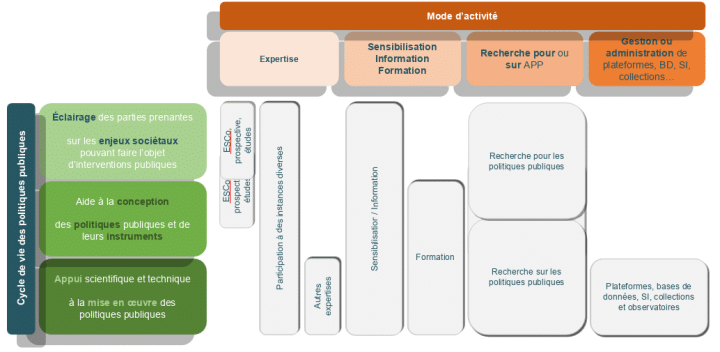
Typology of expertise and public policy support activities
Copyright: Inrae
-
What the scientists say
Good ecological status of watercourses: quantitative hydro-ecology and bioindication
“[…] To ensure that science supports public policy, the role of the research institute remains essential…”
Yves Souchon
Emeritus Research Director, former head of the Quantitative Hydroecology Laboratory, INRAE
Departments providing public policy support
Public policy support is represented on INRAE’s Management Board by the Directorate-General for Expertise and Public Policy Support (DGDEAPP).
Two departments supporting the DGDEAPP provide expertise and support for public policies: the Public Policy Support Division (DAPP) and the Collective Scientific Expertise, Studies and Forecasting Department (DEPE).
In order to inform society and public authorities about the challenges of agriculture, food and the environment, the DEPE carries out collective operations such as collective expert appraisals, foresight and studies, which mobilise scientific experts from INRAE but also from other organisations. These operations, which have tended to be national in scope since the 1990s, are now being expanded to European level.
The mission of the Public Policy Support Division is to facilitate collaboration between INRAE’s scientific teams and public policy players, thereby enhancing the contribution of science to public action. It encourages the organisation of collaborative projects that meet the challenges facing society and is equipped with the appropriate tools and relays. In particular, it negotiates framework agreements between INRAE and public policy players.
Correspondents in scientific departments
To anchor the “public policy support” mission in INRAE’s 14 research departments and their units, 14 Public Policy Support Correspondents (CAPP) contribute to the interface between their department and the Public Policy Support Division.
Collaboration with all INRAE entities
The EAPP works in close collaboration with the research departments, regional research centres and other research support departments to boost partnerships between research and public policy, promote the findings of expert appraisal and public policy support work, and support scientists in recognising, maintaining and developing their skills in public policy support.
Are you a researcher at INRAE? Explore the DAPP intranet
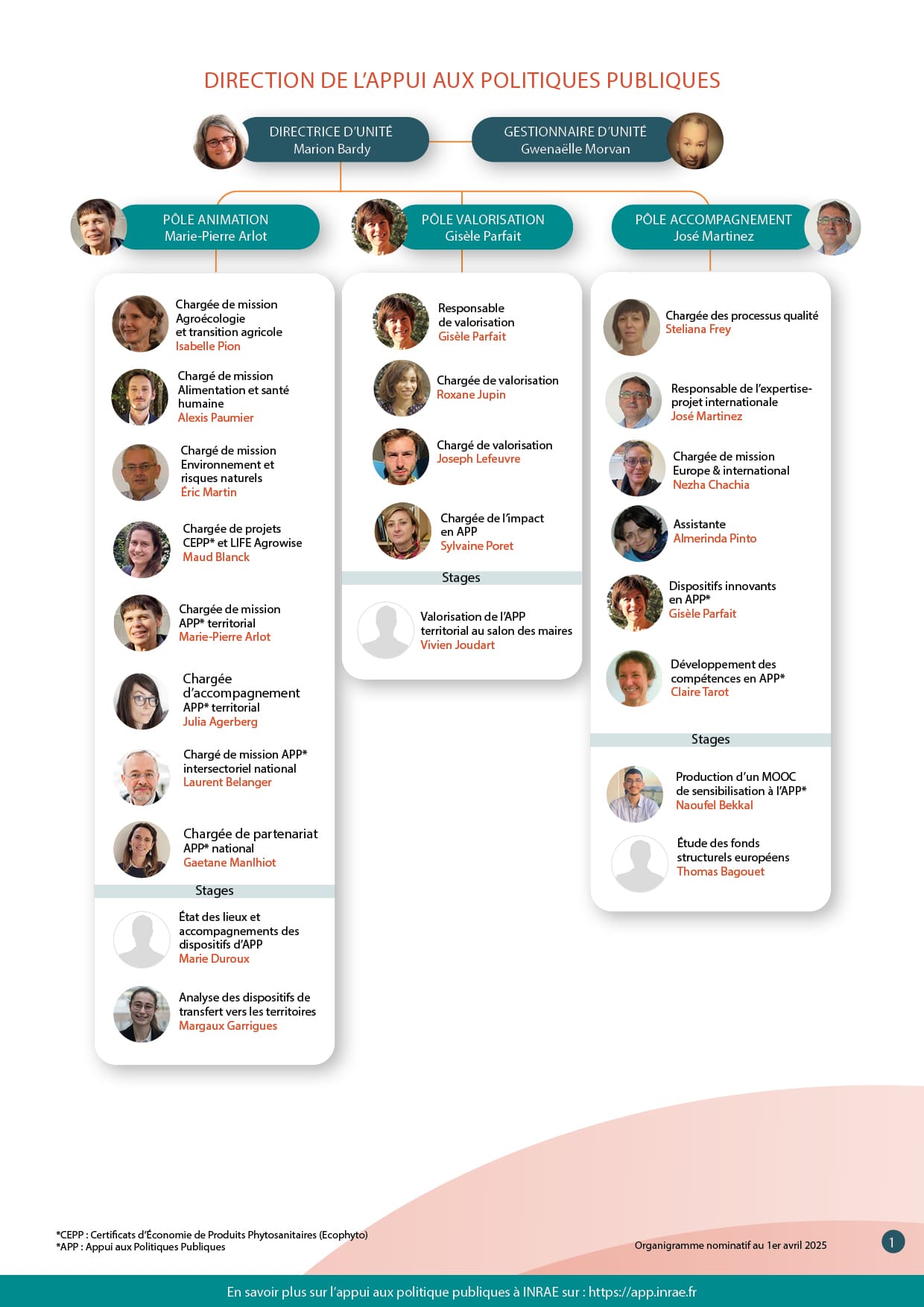
To find out more: The organisation chart of the Public Policy Support Division
-
What the scientists say
From research to expertise and regulation of emerging diseases
“[…] For me, research and expertise are mutually nourishing…”
Christian Ducrot
Animal health epidemiologist, research director, INRAE

-
What the scientists say
From the study of animal behaviour to animal welfare
“I have been studying the behaviour of farm animals and their emotional and cognitive capacities for …
Alain Boissy
Research Director at UMR Herbivores and Director of the National Reference Centre…

Public policy support, an interface between scientists and public policy players
The Public Policy Support Division’s project leaders work with public policy support correspondents in the research departments and scientific leaders to identify possible responses to the needs of public services and public action. They work with scientists to facilitate their support activities for those involved in public policy and action. Lastly, they coordinate public partnerships when drawing up and monitoring framework agreements, national conventions and action programmes.
The aim is to develop a culture of support for public policy, encourage internal and external dialogue to promote these activities and, lastly, to support new scientific approaches to inform public policy and citizens’ behaviours.
See also
“The OFB and INRAE sign a new framework agreement” – Press release
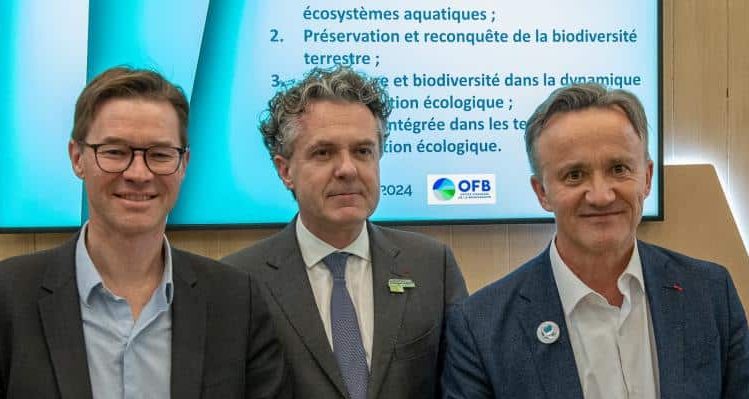
Press release – The OFB and INRAE combine their skills and expertise to support public policies for biodiversity and agroecological transitions.
Public policy support today: a dual benefit
Informing public action requires the mobilisation of qualified scientific-experts who address and dialogue with public stakeholders who are not scientific peers and who generally have a different timeframe for action and decision-making from researchers. This activity calls on specific skills and leads to specific results, which are increasingly taken into account in the evaluation of research groups, researchers and engineers.
These collaborations are formalised by framework agreements and partnership agreements, in various forms: grants, cooperation, quasi-governance contracts, etc. These agreements specify the nature of the scientific support provided to public players and the terms and conditions of this support.
The benefits of public policy support activities are twofold. For public players, it means benefiting from the best advances in science while being assured of their relevance to public decision-making.
For scientists, it means staying on the best scientific fronts with new questions raised by action and the possibility of access to new data, while maintaining their place in society, giving meaning and interest to their work.
“When you hear a farmer tell us that it was thanks to the IDEA method that he started his agroecological transition, and that it helped him to rethink his entire autonomy, obviously, we feel a certain satisfaction”.
Frédéric Zahm
Agro-economist at INRAE
-
What the scientists say
Public authorities and research working together on the OQALI food quality platform
“After joining Anses in 2009, I became head of the Oqali project in 2012, and then of the Oqali unit in …
Julie Gauvreau-Béziat
French Agency for Food, Environmental and Occupational Health and Safety (Anses)

-
Partner’s testimonial
Public authorities and research working together on the OQALI food quality platform
“After joining Anses in 2009, I became head of the Oqali project in 2012, and then of the Oqali unit in …
Julie Gauvreau-Béziat
French Agency for Food, Environmental and Occupational Health and Safety (Anses)
Management in project mode
The management team is organised in project mode, with everyone involved in a partnership that is both internal and external to the Institute. Co-construction, and cooperative methods are favoured with internal partners in public policy support, but also within management, as part of a collective intelligence and skills-sharing approach. The activity is therefore devised with all the entities.
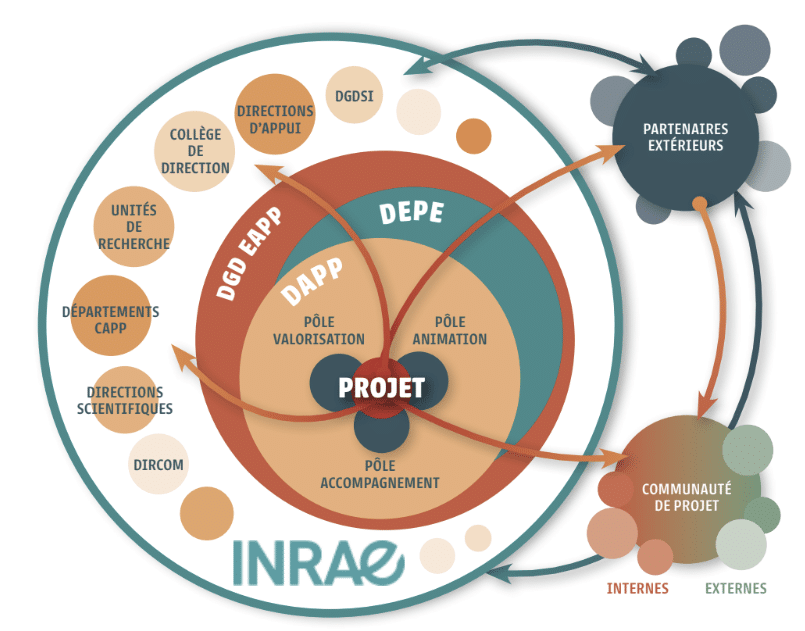
Project mode in the Public Policy Support Division
Copyright : Julie Borgese