Typology of activities in support of public policy
The public policy support provided by INRAE covers a wide range of activities carried out by research units and dedicated internal or partnership structures at regional, national, European and international level.
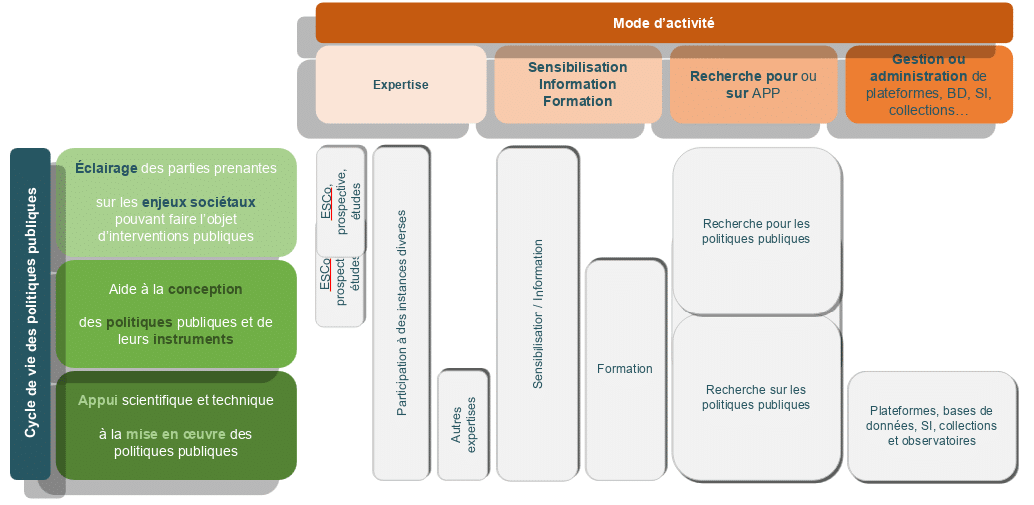
Knowing about these public policy support activities, making them known and recognising them is the first step towards finding one’s way around. INRAE has drawn up a typology of these activities based on two approaches: the main stages in the life cycle of public policies and the types of activities carried out in connection with public policies.
The public policy life cycle
INRAE is involved at all stages of the public policy life cycle.
1. Stakeholder insight
This involves assembling multi-disciplinary knowledge using collective scientific assessments, forecasts or studies carried out under the aegis of INRAE. Certain risk assessment agencies or national, European or international entities may also call on researchers from research organisations to draw up their opinions or enter into collective contracts with certain research units.
2 . Helping design public policies and instruments
This primarily concerns the analysis and ex-ante and ex-post evaluation of public policies relating to INRAE’s themes, and their instruments. This work responds to public requests or calls for research projects. It may form part of framework agreements in which the design, implementation and evaluation of public policies are usually combined. This work may involve all disciplinary fields. It is sometimes the subject of multi-, inter- or trans-disciplinary thinktanks, which may be open to partners. This is also reflected in institute’s scientific experts’ participation in working groups or committees set up by partners.
In addition, to help design public policies, INRAE interacts regularly with members of parliament, notably via the OPECST and various committees.
Lastly, INRAE contributes to training through research and resourcing through professional or continuing training of engineers from the State or local authorities responsible for designing, implementing or evaluating public policies, as well as to the continuing training of certain elected representatives. These public policy players thus have a better scientific knowledge of certain areas in which they are active, which can help them in their missions.
3 . Scientific and technical support to implement public policies
Scientific and technical support combines technical assistance with the production of knowledge, data, models, methods and specific indicators. It mobilises specific research, combined with one-off expert appraisals and opinions, or continuing training operations… It is carried out in research units, experimental units and in specifically dedicated internal or partnership structures, as is the case for the service units of the genetic information processing centre (CTIG) or the rural development observatory (ODR), or by platforms, as in the case of Oqali, AgroSyst, or epidemiosurveillance platforms in animal health, plant health and food chain surveillance. This work may form part of large-scale framework agreements with ministries and their departments (DGPR, DEB, DGAL, DGS, etc.) or with operators dependent on them (OFB, ADEME, ONF, etc.). This aspect of public policy support can also be organised through structures with legal personality such as public interest groups and economic interest groups, such as the GEVES public interest group.
Table of Contents
A typology of activities
Public policy support can be provided at every stage in the life cycle of public policies, in a wide variety of ways at national, European, international and local level. These have been grouped into four main categories, organised into a typology of activities.
Research for and on public policy
Public policy research is any research carried out with the aim of defining, implementing or evaluating a public policy or its instruments, in response to a research question and jointly developed with non-academic public partners. The aim of public policy research is to study a public policy or its instruments, or to propose methods for evaluating public policies.
Expertise in various forms: collective scientific expertise, individual expertise, international expertise, etc.
At INRAE, the term “expertise” is used in a broad sense to encompass a wide range of activities, both in terms of how they are carried out and their purpose. The categories of expertise proposed here do not all correspond in the strictest sense to the existing normative definition.
- Collective scientific expertise, foresight and studies
Expertise covers the coordination of and participation in collective scientific expertise (ESCo), foresight or studies steered by INRAE’s Collective Scientific Expertise, Foresight and Studies Department (DEPE). It also includes the participation of INRAE staff in collective scientific assessments, forecasts or studies coordinated by other higher education or research bodies, public policy players, agencies or consultancies.
- Participation in various organisations
This may involve chairing, leading or participating in committees, technical secretariats or permanent or temporary working groups in expert assessment agencies (ANSES, EFSA, etc.), for regulations or standardisation (AFNOR , CEN, ISO, etc.), or in permanent bodies (scientific councils, policy boards, etc.), non-academic public operators (ministries, agencies, local authorities) or learned societies whose purpose is to support public policies.
- Other forms of expertise, particularly project expertise (national or international)
Expertise covers all forms of individual or collective expertise designed to answer a specific question submitted by a partner involved in the implementation of a public policy, at whatever stage and whatever the public or private status of that partner. This includes, in particular, expert appraisals in support of control services (for example, in the safety of hydraulic engineering structures, or in the field of health). The deliverables can take a variety of forms: reports, tools, methods, guides, etc.
-
What the scientists say
Defining the nutritional quality of meals
“[…] French school catering is an impressive global exception focused on balance and diversity […]”.

Nicole Darmon
Honorary Director of Research, INRAE
Training, information and awareness-raising for public players
Training includes the initial or ongoing training of staff, organisations responsible for public policies or elected representatives, including training through research for State or local authority staff, training teachers and instructors, and designing training modules (pedagogical engineering) and training tools (course materials, manuals, technical guides, etc.).
Awareness-raising and information campaigns are also aimed at organisations responsible for public policy and debate. This may take the form of conferences, symposia, articles in technical or popular magazines or in the media, contributions to newspapers, radio, television or social media. The production of position papers may also be included in this category, provided that they are likely to contribute to public debate in connection with a public policy relating to INRAE’s areas of research.
Designing and managing observatories or databases, information systems and collections
Public policy support also involves managing or administering dedicated systems such as platforms, databases, information systems, collections and observatories, which explicitly meet the needs of public policy makers and are often co-financed with INRAE. For ministries, these include permanent public policy support systems such as epidemiosurveillance platforms (ESV, ESA, SCA), the national soil information system, the rural development observatory (ODR) and the public interest group for seeds (GEVES), as well as other observatory systems or online services involving non-academic public partners.
-
Partner’s testimonial
Maploup, a mediation tool between breeders, shepherds, elected representatives and government departments
“I’m the mayor of a commune in the Belledonne massif, which straddles the departments of Savoie and …
Pierre-Yves Bonnivard
Maire de Saint-Colomban-des-Villards
The public policy life cycle
Copyright: Inrae