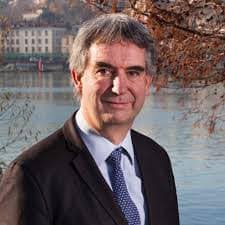
Laurent Roy – Director General of the RMC (Rhône-Méditerranée-Corse) Water Agency, Former Director of Water and Biodiversity at the MTE (Ministry of Ecological Transition) from 2012 to 2015, Former DREAL PACA (testimonial from the dossier “Science and the Water Framework Directive: 20 years of hydrobiology research for the good ecological status of aquatic environments” – 2021)
When the WFD was introduced in the 2000s, you headed three public bodies within the Ministry of the Environment: the DREAL PACA, the DEB and now the RMC Water Agency. What were the knowledge requirements, particularly in terms of bio-indication?
“The WFD imposes an obligation to achieve results, i.e. to return bodies of water to ‘good status’ by 2027 at the latest. The European Commission’s Environment Directorate-General asked Member States to set up a system for assessing the status of continental surface waters. To do this, we needed tools to link pressures and the state of the environment, all documented, robust and filled in at least every 6 years during each assessment cycle. When the WFD was put in place in the 2000s, we were not starting from scratch in France: the system of water management by major river basins was already in place, we had benefited from an environmentally demanding water law since 1992, and research into aquatic ecology by several teams was already well underway. At the time, France was using a bio-indicator for macro-invertebrates, the general biological index (IBGN), a river fish index (IPR), and an index based on diatoms (IBD), which are microscopic algae. The DREALs played an important role in assessing water quality thanks to their hydrobiology laboratories. However, all these tools and knowledge had to be developed to meet WFD objectives, and in particular to have biological indicators that were sensitive to pressures so that actions could be prioritised and targeted more effectively. We still lacked a great deal of knowledge on this point. The DEB and Onema, its operator created in 2007 by the Water Act (Lema), the DREALs, the research community and the water agencies have joined forces to produce the knowledge needed for action. Equipped with substantial resources and with the technical and financial support of the water agencies, Onema has built and financed research agreements on all requirements, surface water, groundwater, risks, etc. with finalised research organisations, including Cemagref, which had been involved in hydrobiology and hydro-ecoregions for years. Thanks to these substantial financial resources, research into bio-indication has been able to intensify.”
What are the constraints involved in producing knowledge for the application of a public policy such as the WFD?
“The tools must be effective and sensitive to pressures. As research has progressed, they have improved, but the system for assessing the state of water set out in the WFD is problematic: if one factor is less than ‘good’, the state of the body of water is downgraded (‘one out all out’ principle). This approach obscures the progress that has been made and makes the assessment of status highly inertial. As a result, tensions emerged between the search for the most relevant indicators possible and the operational requirements to measure and demonstrate the progress achieved by mobilising water stakeholders. The DEB was therefore caught between the scientific output of Onema, then Irstea, the European Commission and its demands for an assessment system that covered as many fields as possible, and the operational services provided by the State (including the Dreal) and the water agencies, the system’s sole financiers. So we had to find a compromise that met all the different requirements. Today, as director of a water agency, I would say that a good number of parameters have undeniably improved, even if the tools used to assess good status mask this real progress. For example, there is 20 times less ammonium, the indicator of ‘domestic’ pollution, in the rivers of the Rhône-Méditerranée basin today than in 1990. The average toxicity of metals, a marker of industrial pollution, has been divided by 6. Monitoring of water status has also considerably improved, with many more analyses being carried out, many more parameters being monitored and constant progress being made in estimating the link between pressures and the functioning of the environment. Improvements in the biology of watercourses have begun to make themselves felt over the last 5 to 6 years, if the I2M2 invertebrate indicator is anything to go by. Science has made an enormous contribution to establishing all these indicators and understanding the links between human activities and the state of the environment. The functional ecology of watercourses and bodies of water is essential if we are to make progress in understanding and choosing the measures to be taken.”
Are there any further research needs?
“We have at least three new challenges ahead of us: 1/ the question of quantity, with climate change set to put increasing pressure on water resources; 2/ the question of diffuse pollution from a multitude of chemical substances, the ‘cocktail’ effects of which are not well understood; and 3/ the pressures on river morphology and the artificialisation of rivers, which is highly detrimental to their good status. The effects of measures in this area are gradual, managers are impatient and our basin committee is asking us for a return on investment. I have noticed that our basin authorities have a strong appetite for knowledge and science, a desire to know more and understand. We have set up a number of meeting places to encourage mutual acculturation and understanding. The next step, which the recent experience of Covid-19 has encouraged us to take, will be to reach out to the general public, who have been stunned to discover science with its doubts and controversies, its unknowns – unsettling for them, but a reality. Decision-makers and legislators need scientists to take action, and scientists must contribute to public decision-making, without taking the place of decision-makers”.
Testimonial from our thematic dossier
Thematic dossier
Science and the Water Framework Directive 20 years of hydrobiology research to achieve good ecological status in aquatic environments
In 2000, the European Water Framework Directive (WFD) set Member States the challenge of restoring European water bodies to good ecological status within twenty years. At the time, knowledge was lacking to implement the directive, so in 2007 the Ministry of the Environment’s Directorate for Water and Biodiversity (DEB) and the National Office for Water and Aquatic Environments (Onema) entered into a major collaboration with a number of research bodies. Cemagref/Irstea and INRA (now INRAE) were among the first partners to join forces, with research being carried out in hydrology, biology and ecology. While work is continuing to achieve the objective of good ecological status, the contributions of science to the implementation of this innovative and ambitious public environmental policy are already significant. A look back at 20 years of collaboration between French research and government departments.