
Bénédicte Augeard – Head of the Research, Development and Innovation Department French Office for Biodiversity OFB (testimony from the dossier “Science and the Water Framework Directive: 20 years of hydrobiology research for good ecological status of aquatic environments” – 2021)
Onema, which has now become the OFB, was created to support the implementation of the WFD, with a great need for new knowledge. What were these needs?
“Onema, which became the French Biodiversity Agency in 2017, then the French Biodiversity Office (OFB) in 2020, was a public body created by the Water and Aquatic Environments Act of 2006 to support the Water and Biodiversity Directorate of the Ministry of the Environment, particularly in the implementation of the European Water Framework Directive (WFD) of 2000. The implementation of the WFD in France raised a large number of research questions. The WFD provided a fairly precise framework for monitoring, assessing and taking action to improve water status: defining types of water body (rivers, lakes and estuaries, coastal waters, groundwater) as a working scale, identifying hydro-ecoregions and reference conditions, and developing indicators to assess ecological status based on fish, invertebrates and algae, for example. Many questions arose in this context, such as how to construct a bio-indicator based on these targeted biological compartments? What measurements should be taken? To assess the impact of which human activities? What references and thresholds should be used for these indicators? How can we prioritise the concrete measures to be taken and assess their effects? The main research requirements to implement the WFD concerned not only qualifying the ecological status of environments, but also the chemical status of water. This qualification involved, on the one hand, issues of metrology and assessing the ecotoxicology of substances, and on the other, establishing a relationship between pressures, human activities and their impact on organisms. Public policy on quantitative water management has also required knowledge of drought and low water levels. Human and social sciences have been useful in supporting reflection on the measures put in place, the economic and social aspects, stakeholder participation, etc. In all these areas, the aim was to develop robust national tools, some of which have now been incorporated into regulations. In the overseas departments, the need for knowledge was even greater than in mainland France. Research resources were weaker and scattered. Very little data was available, which had to be acquired in the field. On behalf of the Ministry, Onema devoted considerable resources to supporting research aimed at public policy. As far as continental surface water is concerned, Cemagref, which became Irstea and now INRAE, played a central role because of its long history in the field, although other research institutes also contributed, notably the former INRA and the University of Lorraine”.
Have the scientific results met the needs of the action?
“On the whole, yes. Researchers were heavily involved in gathering existing data, understanding the framework of the directive, exchanging views with water managers (Onema, the Ministry, DREALs and water agencies) and developing the assessment methods and tools required. When the tools became operational, they were also mobilised to provide support via guides, seminars, training courses and mechanisms such as Aquaref. These exchanges between researchers and managers throughout the projects are a real asset to ensure that the research results are operational. This work has enabled many researchers to advance their understanding of ecological processes and to use the results in academic publications. Bio-indication is a complex issue that requires a good understanding of the ecology of environments, species’ sensitivity to pollution and habitats, interactions between species and the evolutionary trajectories of ecosystems. Working with large volumes of data from WFD monitoring can bring out relationships that then need to be properly characterised. Other advances have been made with INRA, now INRAE, on the link between agricultural practices and diffuse water pollution, on quantitative approaches to water use, and on new monitoring methods using environmental DNA for faster diagnosis. However, it has not been possible to use all the tools developed. As the monitoring network was set up and the knowledge produced by research increased, we had increasingly accurate tools at our disposal, but these downgraded the overall status of water bodies, masking the efforts made to re-establish good status, and risking managers’ discouragement. The historical river fish indicator, the RPI, had been improved in its RPI+ version, becoming a powerful diagnostic tool. However, it was not included in the regulations, as its sensitivity was such that it downgraded the status of water bodies too much. It was complicated for water managers to show such a significant deterioration in the ecological status of bodies of water without any link to an increase in the explanatory factors. This indicator is therefore used more for one-off diagnostics.”
Do public policies need science?
“Of course; the work discussed above demonstrates this for the WFD. Similar questions are now being asked in relation to the implementation of the European Marine Strategy Framework Directive (MSFD): how to set up a monitoring system, develop descriptors of the ecological status of the marine environment, define management objectives and measures, etc. Research is also eagerly awaited in this area. It requires an awareness of what we know and what we don’t yet know, and an ability to explain uncertainties… However, it is important to make a clear distinction between the scientific approach, its results, and the use that will be made of them for action by stakeholders. Working with researchers in ecology or water science enriches the regulations, but they are not based solely on scientific knowledge and incorporate many other societal issues to ensure that they are applicable. Beyond the needs of public policy, scientists also have a role to play in informing society’s other players – businesses, NGOs and citizens – who are also affected by water and environmental management issues. Dialogue with society must be encouraged to raise awareness of the issues and get things moving.”
Testimonial from our thematic dossier
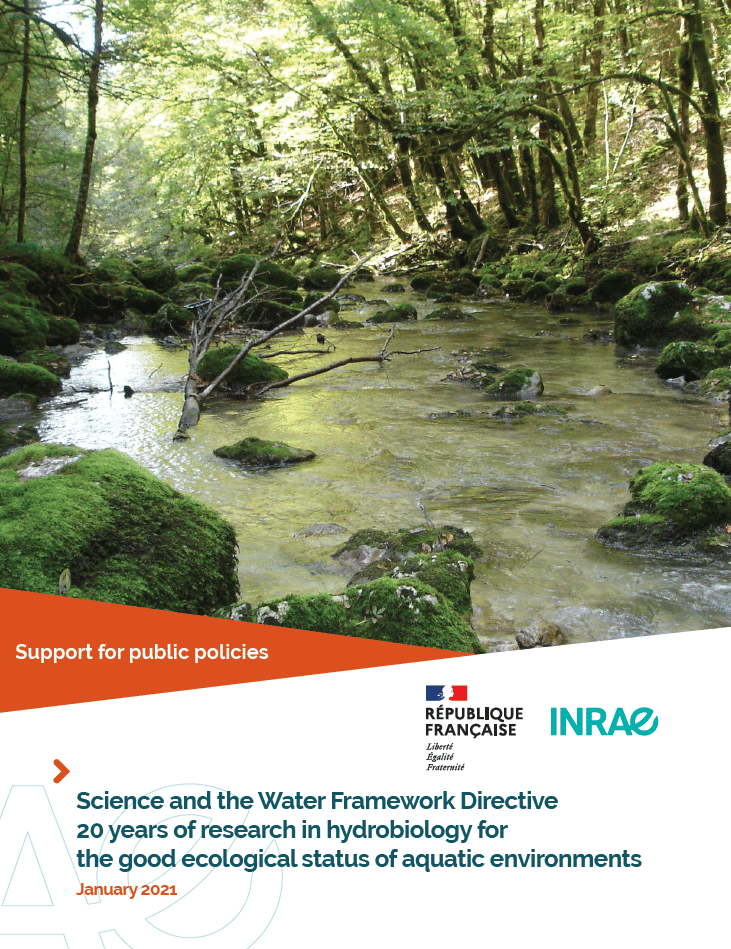
Thematic dossier
Science and the Water Framework Directive 20 years of hydrobiology research to achieve good ecological status in aquatic environments
In 2000, the European Water Framework Directive (WFD) set Member States the challenge of restoring European water bodies to good ecological status within twenty years. At the time, knowledge was lacking to implement the directive, so in 2007 the Ministry of the Environment’s Directorate for Water and Biodiversity (DEB) and the National Office for Water and Aquatic Environments (Onema) entered into a major collaboration with a number of research bodies. Cemagref/Irstea and INRA (now INRAE) were among the first partners to join forces, with research being carried out in hydrology, biology and ecology. While work is continuing to achieve the objective of good ecological status, the contributions of science to the implementation of this innovative and ambitious public environmental policy are already significant. A look back at 20 years of collaboration between French research and government departments.