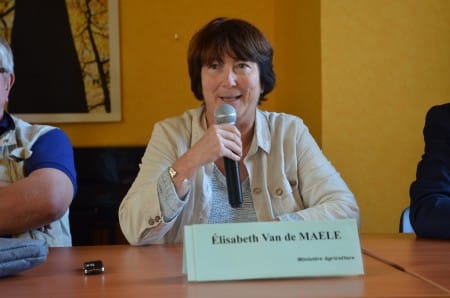
Élisabeth Van de Maele – Head of the Sustainable Forest and Wood Management Office (BGED), Directorate General for the Economic and Environmental Performance of Enterprises (DGPE), Ministry of Agriculture and Food (testimony from the dossier “Forest reproductive material: a challenge for the forests of tomorrow” – 2022)
3 questions for Élisabeth Van de Maele
You are in charge of the Sustainable Forest and Wood Management office. What are its prerogatives?
“I trained as an agronomist and have held a number of positions in different agricultural sectors at the Ministry of Agriculture. I’ve been working on forestry issues for a dozen years now, including 6 years in the Sustainable Forest and Wood Management office. We are a team of 10 people working on a wide range of issues. The office’s mission is to facilitate the implementation of national and European public forestry policies. Biodiversity is an important component of these policies. As such, we maintain close relations with the Ministry of Ecological Transition. We have a cross-disciplinary approach to forestry issues, which includes sustainable management, knowledge and protection of the forest, natural risks, and environmental services, as well as the forest-society relationship and, of course, adaptation to climate change. A significant amount of research and development is devoted to this last theme. Lastly, one of the main themes followed by the office covers forest genetic resources (FGR) and forest reproductive material (FRM).”
What are the challenges facing forests today and in the future, as supported by the Ministry of Agriculture?
“Today, as in the future, forest management will have to reconcile production and protection. The criteria to be taken into account in forest renewal today encompass both the economic need to produce quality wood for different uses in the industry, and the resilience of forests and their protection against natural and human-caused risks such as fires and emerging diseases. Based on scientific knowledge, species selection criteria have evolved, moving from a focus on adaptation to the site, growth potential and wood quality, to prioritising species with a high capacity to adapt to global change. The biggest challenge facing tomorrow’s forests is adapting to climate change. It impacts every aspect of the forest and makes its management even more complex. This is an observation shared by all the stakeholders in the forestry sector. Only a healthy forest can continue to fulfil its many functions, including as a carbon sink. The future remains uncertain, which makes the choice of species and forest reproductive material for the renewal of stands even more complex, because we need to find the right balance between resilience and competitive timber production, all in a dynamic of close dialogue with regions.”
How do scientific support and public policy work together in the forestry sector?
“The selection of forest reproductive material has to anticipate rapidly changing needs, even though forestry is a long-term process. Producing seeds and seedlings for tomorrow’s forests requires considerable investment and time, and is becoming increasingly complex. For example, it takes more than ten years on average for a forest seed orchard to come into production. But we often forget that it also takes between 5 and 10 years upstream, from the decision to install a seed orchard to its planting, because this requires an improved population, which in turn requires continuous genetic improvement – genetic recombination, evaluation, genetic selection – carried out by INRAE researchers. Anticipation is therefore a key factor in designing and implementing forestry policy. In fact, it is thanks to this foresight that we were able to respond rapidly in 2021 to the Recovery Plan by devoting €1 million to the creation of seed orchards for promising species such as Atlas cedar, Douglas fir and downy oak. Responsibility for this lies with the French government, supported by its operators ONF and INRAE. The need for science is considerable, and the Ministry of Agriculture has been relying on INRAE scientists for a very long time. There is, therefore, a huge need for skills relating to the design and management of seed orchards and the evaluation of the forest reproductive material made available. At the close of the ‘Assises de la forêt et du bois’ conference, it was confirmed that R&D into the production of forest reproductive material adapted to the future climate would be boosted by 500,000 euros per year. In various bodies such as the Forest Genetic Resources Commission (CRGF), the Permanent Technical Selection Committee (CTPS) for the forest tree section and the Technical Coordination Committee (CTC) for State seed orchards, INRAE scientists not only help us conserve FGR, select classified stands and create seed orchards, but also advise us on the use of forest reproductive material to renew our forests. This advice is particularly valuable support, based on several expert opinions for the same species, which the INRAE experts can provide. In addition to its support for seed orchards, INRAE provides its expertise in experimenting with forest renewal solutions (RENFOR division) and in monitoring numerous long-term experimentation and observation networks (In-Sylva, ICOS, AnaEE-France, TreeDivnet). To meet these long-term challenges, public forestry policy must also be a long-term process, informed by the results of scientific research. Acquiring knowledge is essential in a technically highly complex field, to enable the State to anticipate uncertain climatic conditions.”
Testimonial from our thematic dossier
Thematic dossier
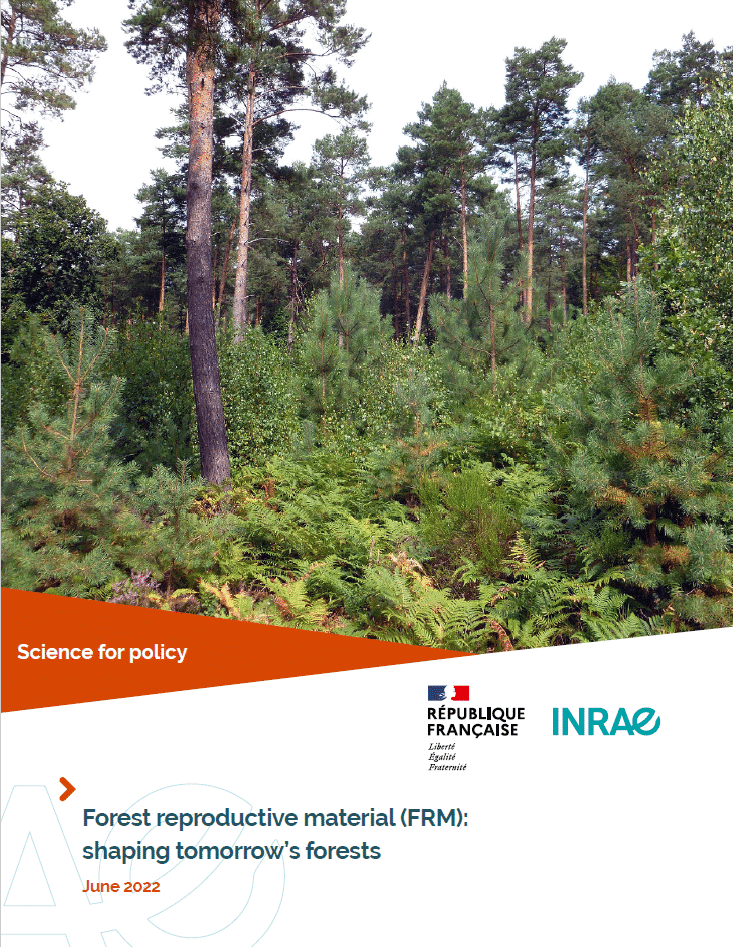
Forest reproductive material: a challenge for the forests of tomorrow
Thanks to French public policies focused on reforestation through planting, France has increased its forest area by 1.5 million hectares in 50 years. But the adaptability of the species used for reforestation raises questions: what characteristics are important for the trees of tomorrow? Which species should be planted where? What inter- and intraspecific genetic diversity needs should be anticipated? INRAE’s work on the varietal selection of forest species and the creation and management of seed production structures (seed orchards and seed-bearing stands) is helping to design a more resilient forest by guaranteeing the genetic origin and quality of forest seeds.