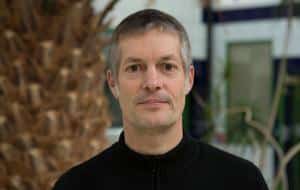
Sylvain Ballu – Agricultural engineer, green tide monitoring project leader Centre d’étude et de valorisation des algues (CEVA) (testimonial from the dossier “From the European Nitrates Directive to green algae plans in Brittany: the contributions of INRAE scientists” – 2022)
“I joined the CEVA in 2001, working on the assessment of green tides through the acquisition and processing of aerial images. The local authorities in Brittany were setting up a programme to combat green tides in their catchment areas, and CEVA was the programme coordinator until 2007. We supported the local authorities by facilitating the sharing of experience and links with river basin managers and researchers, notably INRAE and Ifremer. To take appropriate measures, the scientific point of view is fundamental, and we turned to INRAE for advice on agronomic issues. We are working on modelling the continuum of nitrate flows from the plot of land to the coast, using INRAE’s TNT2 model for the land-based part. Water quality measurements currently show a reduction in nitrate levels at all outlets. Despite this, the winter carry-over of ulva stocks from one year to the next and the increase in flows in some sectors (east of the Côtes-d’Armor) due to the intense storms of recent years have increased the development of algae in certain years. Their proliferation is multi-factorial and the challenge is to gain a better understanding of the contribution of each parameter and the levels of action required to achieve the long-term objectives of restoring the coastal environment.”
Testimonial from our special report
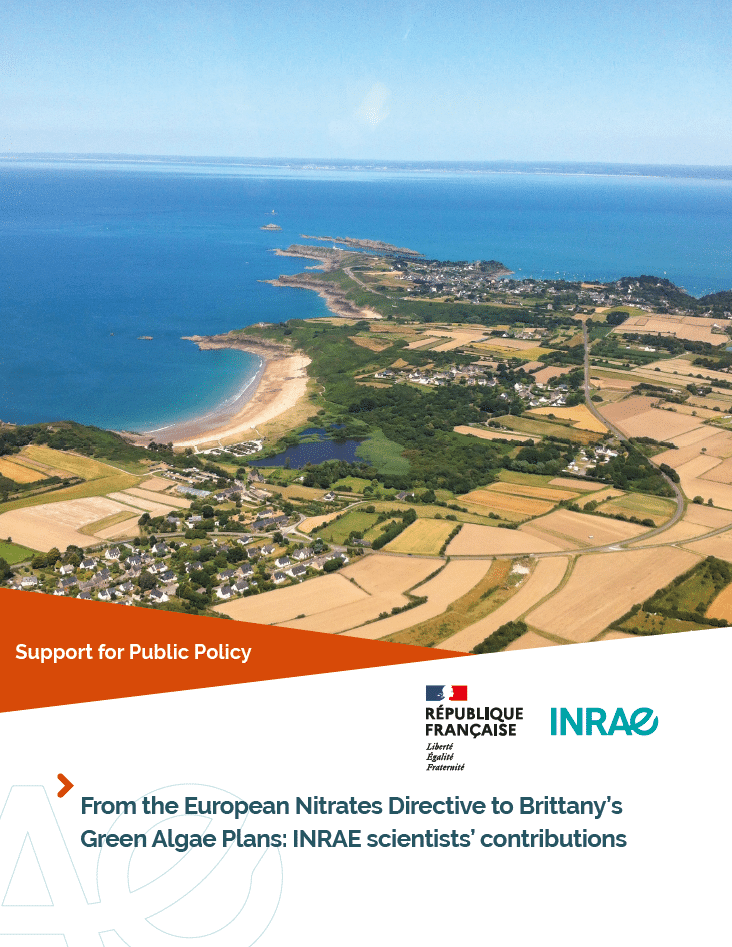
Thematic dossier
From the European Nitrates Directive to green algae plans in Brittany: the contributions of INRAE scientists
Since the 1970s, researchers at the Institute have been studying nitrate flows of agricultural origin from the plot to the catchment area and their impact on the biological balance of aquatic environments. The agri-hydrological models they have developed have provided a better understanding of nitrate flows and helped local players to implement regional policies. With the deployment of plans to combat green algae in Brittany (PLAV), scientists have gradually moved from the position of experts providing advice to that of mediators supporting the various stakeholders by sharing scientific knowledge on the subject. These years of experience have led to the creation of a training course dedicated to new elected representatives who are likely to become involved in the PLAV, capitalising on the knowledge of former elected representatives and on scientific knowledge.